
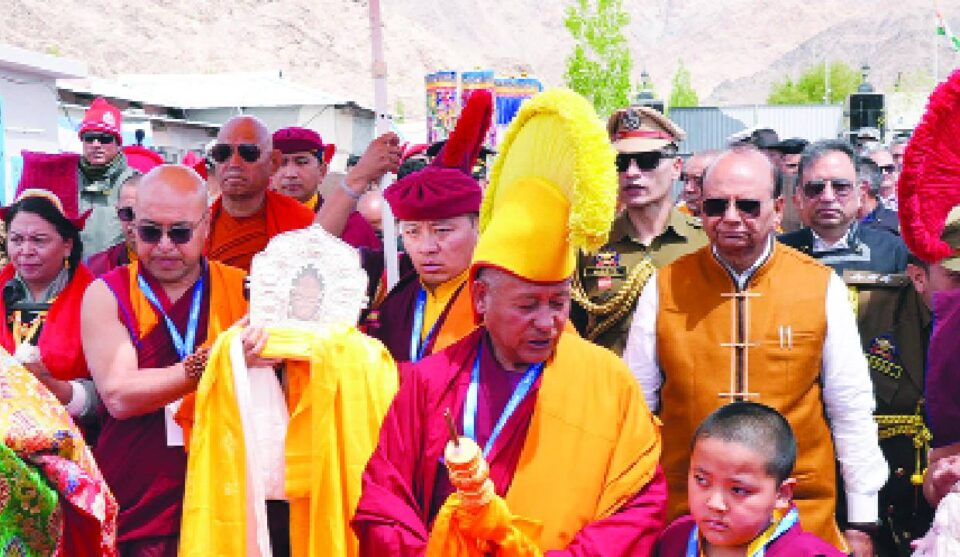
The members of the two prominent representative bodies, spearheading a campaign in support of statehood for Ladakh and the extension of the Sixth Schedule of the Constitution to the region, have set their eyes on the visit of the Union Home Minister Amit Shah to Leh to pay respects to the sacred relics of Lord Buddha on Buddha Purnima.
The combined leadership of the Leh Apex body (LAB) and the Kargil Democratic Alliance (KDA) have also appealed to the Union Home Minister to hold deliberations with them during his two-day-long stay in the region.
Addressing a joint press conference after their internal meeting, LAB co-chairman Chering Dorjay Lakruk appealed to Home Minister Amit Shah to hold detailed discussions with the LAB and KDA during his visit to Ladakh for meaningful dialogue.
“Shah once said that he will chair the High-Powered Committee (HPC) meeting. It’s time for him to hold the meeting,” he said, adding they are not expecting much from the May 22 Sub-Committee meeting called by the Union Home Ministry as it has limited people and can’t take big decisions, especially on their demands for Statehood and Sixth Schedule status.
Lakruk told local reporters in Leh that they have submitted their document on Statehood and Sixth Schedule status, which the MHA has studied as well. “Now is the time for them to react,” he added.
The LAB co-chairman said if the MHA doesn’t agree to their demands, their struggle will continue.
Meanwhile, a Kargil-based political activist, Sajjad Kargili, on Wednesday issued a statement in which he said the recent decision of the Government to create five new districts in Ladakh —raising the total from two to seven — appears less an administrative reform and more a calculated attempt to fragment the unified democratic and statehood movement of the people of Ladakh, particularly the collective voice of both Buddhists and Muslims.
Kargili said the process has clearly ignored regional sensitivities, demographic realities, and principles of equitable representation. As per the 2011 Census, Ladakh has a population of 2,74,289, of which approximately 46.40 per cent are Muslims and 39.65 per cent are Buddhists. However, the current reorganisation results in five Buddhist-majority districts and only two Muslim-majority districts. This disproportionate distribution reflects a deeply skewed and discriminatory approach, undermining the spirit of fairness and inclusivity.
He said, “We strongly oppose this arbitrary and insensitive restructuring. In particular, we reiterate the genuine and long-pending demand for granting district status to Sankoo-Suru and Shakar Chiktan. The people of these regions have repeatedly submitted memorandums to the Government, presenting justified and well-founded demands, yet they have been consistently ignored”.